Monday, May 23, 2011

Haifa: Stella Maris Carmelite Church & Monastery

After my time at Elijah's Cave, I took the cable car at the base of the mountain up to the top of the mountain, where the Carmelite Monastery is located. This was my first visit to a church on this trip so far. As I walked in to the church, I was struck by the familiarity of it all. A monk sat by the door in his brown robes, and statues of Jesus and Mary adorned the altar area. Beneath the altar there was a cave-like area with a place to light candles and a picture of someone -- I couldn't tell who it was supposed to be since the signs were only in Arabic and English. (Maybe Elijah?) But I lit a candle anyway, and said a prayer.


It was about 5:30 p.m., so I sat down in the church in a pew and said Evening Prayer, whispering to myself in the hush of this sacred space. I'd started the morning chanting Morning Prayer aloud in the silence and stillness of my room in Akko, and in the space of time between then and now, I'd visited a Baha'i sacred site, been given a ride to the train station by the Jewish hostel owner, who was on his way to a Hebrew lecture in biblical studies at a university in Tel Aviv, talked to several people on the train to Haifa, including a young boy who told me in English, "If you want to see the REAL Israel, go to the beach!," visited a site sacred to Jews, Christians, and Muslims alike (Elijah's Cave) -- although it was certainly Jewish-centric, and now found myself at the top of Mount Carmel in a church attached to a monastery, saying Evening Prayer.

Afterwards, I treated myself to dinner in a restaurant overlooking the Mediterranean from the top of the hill and then walked back to the hostel, talking the scenic Stella Maris Road down Mount Carmel and passing locals running up the mountain, out for their evening exercise. I passed by the base of the Baha'i World Center in Haifa on my way back and got my first glimpse of the magnificent structure, much larger than the center in Akko.

Haifa: Elijah's Cave

The organization and structure of the Baha'i gardens, both in the careful and meticulous landscaping and in the way visitors were managed, was a stark contrast to the somewhat chaotic site of Elijah's Cave in Haifa that I visited next.


First of all, there were no signs in English directly at the site of Elijah's cave; the woman at the hostel had warned me that it was "not obvious" where the entrance was. I saw several tour buses parked by the side of the road and crowds of Jewish people with yarmulkes walking down the mountain on an elevated pathway. "Well, that must be it," I thought. I found my way to an entrance to a walkway and made my way up the mountain, following the flow of people.

As I neared the top of the ramp, I heard loud Middle Eastern music playing (it wasn't clear if it was Hebrew or Arabic to me) and smelled food cooking. Suddenly I worried that I was in the wrong place; perhaps I was headed to a restaurant or some kind of park area where these folks were all having a big cook-out party! I cautiously continued up the last flight of stairs, and spotted a small plaque to the right of the gate that had an English translation: "Elijah's Cave," it said. "O-kaaaay," I thought, and headed on in.


The courtyard area indeed looked like it was a public picnic area, with kids running up and down and a large grill area with some kind of food smoking on it and lots of people sitting down eating at tables. I followed the stairs up to the next level and saw a large elaborate chair with Hebrew written all over it -- "Ah!" I thought, "This must be Elijah's chair -- the chair that is left empty at every Passover dinner with the expectations that the prophet might return." There were stations for lighting memorial candles, although I'm not sure for what, since everything was in Hebrew.


I followed the steps up to the entrance to the cave area, and saw a large room with a divider down the middle of it. "Women Side / Men Side" said the sign, in Hebrew, Arabic, and English -- and that was the extent that there was anything written in anything other than Hebrew in the entire place. There was a box of scarfs by the entrance, and since I'd forgotten to bring mine (it was in my backpack back at the hostel), I picked one up and put it on and entered the women's side.

The area where the actual cave space was was covered with a thick velvet cloth, with a Star of David on the front of it. I assumed this meant that it was off-limits, that people weren't allowed to go in there. I looked at the displays on the dividing walls, since there were many pictures, even though I couldn't read the descriptions. There were depictions of Elijah from various biblical stories, and against the wall where the cave was, several tablets with the tetragrammon -- the four consonants of the Name of God in Hebrew.

Off to the left side of the large room was a smaller nook with an area where there was a Torah scroll, with a curtain drawn in front of it as well. Women were going into that space and resting their hands and faces against the curtain, saying prayers. There were pieces of paper shoved into the cracks in the walls -- like at the Western Wall in Jerusalem -- representing prayers offered by the pilgrims who had visited here. There were also all kinds of scarves and hair pieces -- clips, rubber bands, etc -- tied to the metal wires in the ceiling of this cave area. I wasn't sure what the significance of that practice was, but clearly it was a "thing" that people did here.

I sat down in the Torah nook area to read the story of Elijah fighting the prophets of Ba'al from 1 Kings, along with the prayers and reflections in my Jewish pilgrimage guide. After a while, a young woman in an Israeli military uniform joined me, sitting on the rug facing the Torah area and reading her prayer book, rocking back and forth in the methodical way Jews do at prayer. On the other side of the dividing wall, a group of men were praying together, loudly, a leader shouting phrases in Hebrew punctuated by the group's vigorous "AMEN!!"s. In the background, the blasting music from the courtyard drifted in on top of it all.

As I sat, some new women walked into the larger room area, and I watched them walk up to the curtain that I had assumed was sacrosanct and untouchable and grab it and fling it back with all the hutzpah and casualness as if they were pushing past someone that was in their way in a shopping mall, and step right inside the cave. "Oh!" I thought. "I guess we CAN go in there after all!" I watched as a whole group of women came in, a few at a time, paying their respects to this place where Elijah was said to have stayed, some with deep reverence, others casually, with a plate of food in one hand even as they stepped inside the cave.

After the crowd cleared away, I went and stepped in the cave myself. It was just me and one another woman, who was leaning against the wall and praying with her Hebrew prayer book or Bible. As I placed my hand on the wall, I felt the same shiver of holiness that I had felt as I stood beside Baha'u'llah's grave in Akko.

I was struck by how opposite this was from the utter silence and stillness that the Baha'is were so careful to protect around the shrine of Baha'u'llah in Akko. In place of structured, beautifully manicured and landscaped gardens, there was dirt and grime and trash and the scent of food. Instead of silence, there was shouting prayers and throbbing music. The Baha'i site reminded me of the "frozen chosen" denominations of Christianity -- valuing silence and stillness and order and beauty -- and Elijah's Cave reminded me of the Pentecostal or more spirit-led denominations of Christianity.

In reflecting on one of my "guiding questions" for the trip -- "How do I experience God in the sacred spaces of other traditions?" -- I found that I experienced both places to be sacred, in their different ways. The structure and order and meticulous attention to detail were beautiful, but so was the chaos. Just as I am not satisfied with one kind of liturgy or experience of the Christian faith, I would not have wanted to have visited all sites like the Baha'i gardens or all sites like Elijah's Cave. I like both… I need both.

Akko - Baha'i Garden


The Baha'i gardens in Akko, according to the informational signs posted there, is considered the "most holy place on earth" by Baha'is, since the founder of their faith, Baha'u'llah, is buried there. I have long been drawn to the Baha'i Faith, with its clear message of equality between all people regardless of race or gender. In this regard, it is similar to Sikhism, and I have often thought that it must be much easier for Baha'is and Sikhs to advocate for rights for women, for instance, than for Christians, when our tradition includes things like, "Women, submit to your husbands" (c.f. Ephesians 5) in our scriptures.

Since I first learned about The Baha'i Faith, I have felt drawn to it, and from my many engagements with the faith over the years, I have come to conclude that if I were not a Christian, I would likely be a Baha'i. (Baha'is do not see those terms as mutually exclusive, but the Church does.) The Baha'is I have known over the years have all been exceptionally kind, open-hearted, spiritually-grounded people. And the Baha'i Faith teaches that Baha'u'llah was the Second Coming of Christ. Even if this claim marks them as heretics in the eyes of the Church, it certainly provides food for thought on our own relationship with Judaism. We maintain that the Jews "got it wrong" as a whole in not recognizing that Jesus was the Messiah promised to Israel. In a similar fashion, Baha'is believe Christians have "gotten it wrong" in not recognizing the Second Coming of Christ when he was here on earth -- in the form of the prophet Baha'u'llah.

In any case, there were many reasons that I, as a Christian, felt drawn to visit the shrine of Baha'u'llah. Today was one of the days that the shrine and inner gardens are open to non-Baha'is, and I scheduled my visit intentionally so I could visit the shrine.

As I stepped inside the building where Baha'u'llah is buried, I felt a sense of peace and calm. The inside of the building has an interior courtyard with beautiful plants and flowers, and the floors of the entire building are covered in oriental rugs. We were barefoot, since it is required to remove one's shoes before entering. Off to the side of the courtyard are several empty rooms that the guide told us were used by Baha'is to pray when they come to this place on pilgrimage. I thought of my Baha'i friends back in Atlanta, with whom I used to share food and prayers and fellowship on Monday nights, and pictured them here, moving gracefully on bare feet from the side rooms over to the room where Baha'u'llah is buried, lifting their hands in prayer and praise, deeply absorbed in the holiness of this place.

I looked at the guide as she was directing the few other people in the shrine back outside.

"Would it be possible for me to stay and pray?" I asked.

"Of course," she said with a gentle smile.

I sat by the tomb of Baha'u'llah and read the Tablet of Visitation, the text that Baha'is read when they come on pilgrimage here. Then I closed my eyes and sat in my own silent prayer, thanking God for the witness of Baha'u'llah and for the people of this faith who have brought so much love and light to the world.

Although I had found the strict regulation of the flow of people into the shrine to be a bit intimidating and off-putting when I first arrived (I was told by a guard at the gate to the inner gardens that there were several groups inside the shrine currently and that I would have to wait 10 minutes or so before I could enter), once I was inside and praying I was very grateful for the regulation, which meant that each group of visitors were able to visit the shrine in a quiet and calm atmosphere, not amdist the hustle and bustle of large groups of people.

Sunday, May 22, 2011

What was I thinking???

Today the reality of the fact that I am going to be traveling alone in a foreign country where I do not speak the language began to sink in. After a nice weekend spent with Naomi and Yinon and Aya, where they drove me around and ordered my ice cream and french fries for me by the port in Tel Aviv, it was time to venture out without my translators.

The thought of this triggered a great deal of panic.

"Stay calm," I told myself, "you can do this. Remember when you and Susan traveled to Paris together after foreign study? And your trip with Ashley to Germany in 2005? You can do this."

The only problem was, in neither of those cases was I alone, and in the first case, I spoke enough French to at least get by (calling back all those years of French in middle school, high school, and college), and in the second case, my sister was semi-fluent in German as we traveled together in Germany and Austria.

The one case when I was both without someone who spoke the language and traveling semi-alone was when Susan and I first left our school group in Rome at the end of our foreign study trip in college and headed towards Paris via the train. The Italian train company was having some kind of strike, so we decided to stop in Turin (Torino) that first night and spend two nights there. Problem was, we didn't have any plans or arrangements made for that visit.

We got off the train and found ourselves in the middle of a northern Italian city where English speakers were much more rare than in cosmopolitan Rome. We had a guide book with us and were trying to find a hostel listed in there, but were having trouble. We tried to ask someone on the street, and the person we flagged down didn't speak a word of English. I kept speaking to them in English and pointing at the map and waving my arms around and pointing, trying to communicate that we needed directions to this particular place. The person were talking to kept speaking in Italian and gesturing and pointing and looking at the map and pointing, but no amount of gesturing and pointing and continuing to speak in our own languages was going to help.

The feeling that came over me at that point was one of sheer panic. "Holy crap," I thought, "I'm in a foreign country where I don't speak the language, by myself, and I have no way of communicating with these people! ACK!!!!!!!!" The feeling of helplessness and isolation was overwhelming. I never wanted to repeat that experience.

But today, I did.

My worst fears were realized in my very first solo outing. I walked down the street from Naomi's apartment to go to the ATM and get some local currency so I could take taxis and pay the balance on my hostels that didn't take credit cards, and I decided to go to the grocery store next to the ATM to get some hummus and hallah bread -- the same combination I'd had at Naomi's that was delicious and I figured that could be my lunch. Grocery stores are usually a cheaper way to go for eating anyway, I figured, it's right here, and if the person at the counter doesn't speak English, well, all that buying something really requires is seeing the total on the cash register and handing them the correct money. Half the time cashiers hardly speak to you in America anyway. I figured it was a safe first try.

Unfortunately, I was wrong. The check out cashier spoke no English, and apparently there was some issue, because she kept trying to say things to me in Hebrew, and all I could do was just smile apologetically and look uneasy, feeling increasingly panicked and helpless, as I had that day on the street in Torino. (I think maybe she was trying to figure out the cost of the bread, since it came from the bakery section and didn't have a price tag on it.) Eventually she punched in a bunch of things and told me the price, rapidly, in Hebrew. I peered over to the cash register screen and saw my total: 12.57 (a little over three dollars). I gave her a 50 shekel note, waited for my change, walked out of the store, and proceeded to burst into tears.

"What was I THINKING???????" I screamed at myself internally. "This was CRAZY! I can't do this!!! I want to go home. I will never travel alone to a country where I don't speak the language again. I don't want to be here!"

After retreating to Naomi's apartment and sobbing for a while as Naomi tried to assure me everything would be ok, I finally left for the train station. I couldn't stay holed up in Naomi's apartment forever. I have three weeks to kill before my flight leaves for the U.S.

The plan was to take a train to Akko, where I would stay overnight and then get up in the morning to see the Bahá'í gardens in Akko. Naomi walked me down and hailed a cab for me in front of her apartment building, and gave instructions to the driver in Hebrew. "Ok, he's all set," she said to me as she hugged me and put me into the cab, assuring me I could call her any time.

As we took off down the road, the cab driver spoke to me in English. A wave of relief flooded over me. Disaster averted in this particular case.

After I got to the train station, I made it through the security checkpoint and then tried to figure out how to get my ticket. After observing several people walk away in exasperation from the electronic ticket machine and go over to the cashier behind the counter, I inferred that the machine must be broken. So, I got my money out and got in line. At the counter, I timidly said, "Akko?" and accepted my change and my ticket. Unfortunately, the ticket was entirely in Hebrew and I couldn't make out any of the words as being anything close to "Akko" in Hebrew script (I do know the Hebrew alphabet, thanks to a biblical Hebrew class at Furman many years ago -- thanks, Bryan Bibb!!!).

There were several different platforms, so I stood helplessly in the middle of the station looking for some indication of where I needed to go. Finally I approached a woman behind the counter of a convenience store/fast food kind of place in the station and asked if she spoke English. She did, and helped me figure out which platform to go to.

After getting on the wrong train once, getting on the right train but barely (getting squished in, standing room only), being delayed for nearly an hour due to some reason I couldn't understand since all the announcements were in Hebrew, finally getting to sit down, falling asleep and missing my stop, and getting back on the train going in the opposite direction, I finally arrived in Akko, an hour and a half later than I'd planned to arrive.

I got a cab at the train station, but the cab driver spoke only a little English and didn't know where the hostel I was going to was located. Luckily, I had their phone number handy and was able to give it to the cab driver so he could call them and ask directions in Hebrew. That worked, and so finally I arrived at my first hostel -- the Western Galilee Inn in Bustan Ha-Galil, a small village north of Akko. It is actually a series of guest houses on a small farm, in what felt like the middle of nowhere. A woman met me and showed me in to my room, which was in a completely empty guest house. Despite having eight bunk beds, I am apparently the only occupant tonight. After the day's trials and tribulations, I am more than grateful for the silence and privacy.

My home for tonight.

Saturday, May 21, 2011

Tel Aviv

I began my pilgrimage today with a visit to that most sacred of religious sites... the beach!


Yinon and Aya getting some water for making sand castles on the beach.

Naomi, Yinon, Aya, and I spent the morning on the beach in Tel Aviv, then came back to the apartment for lunch and a nap (for all!) and then went out to the old port area and walked around the boardwalk in the evening. It was a nice, relaxing day and fun to spend time with them as I get settled in and adjusted to the new time zone and all. Tomorrow the real pilgrimage starts.

Naomi and Aya in their apartment

Friday, May 20, 2011

I have arrived in the land of Israel

As I stepped off the plane, I was surprised by how familiar it all seemed. The tall glass buildings, the escalators... it felt like I could have been in any airport in America... O'Hare... or Charlotte Douglas... or Boston Logan. In my previous travels to foreign countries -- even to Canada -- I have instantly felt an air of "difference" in the air the second I stepped off the plane, knowing viscerally in my bones, even if someone had me blindfolded, that I was in a different country. I don't know that I would have known I was in a different country if I had arrived in Israel blindfolded.

My friend's husband Yinon met me at the airport and drove me back to their apartment. It all seemed so "normal" -- paying for the parking ticket in the automated machine (even if it was all in Hebrew), getting in the car in the parking garage, driving along the city streets of Tel Aviv to an apartment complex. I've been mulling over what's different about this trip, why I feel so much less "out of place" here than I have in other countries I've traveled to. Is it that Israel is so influenced by America and so many American-born people find there way here to live? Or is it, perhaps, that I am a different person than I was in 2005, the last time I left the country? That perhaps I am a bit less timid, a bit more comfortable with difference, a bit more at home amidst the "foreign"?

Yinon drove me to their home and impressed me with his knowledge of the history of the Episcopal Church along the way. He grew up in Israel and studied both Christianity and Islam in grade school, and did some kind of graduate study in history, including Western history, which of course, included the history of Christianity. But somehow he remembered amazing amounts of detail particularly about Episcopal Church history, things I didn't even know before I went to seminary. He could have passed Ben King's Church History course with flying colors! I was very impressed.

"Well, I certainly didn't expect to get a re-cap of Episcopal Church History upon my arrival in Israel," I said with a laugh.

"Oh, I'm sorry," he said, quickly.

"No, no, no," I said. "This is great! That's very impressive that you know all that!"

"So my history of Christianity is pretty good?" he said, with a smile.

As we arrived at the apartment, our conversation shifted to the weight that ordained people carry in terms of the power they wield in the pulpit, for good or for ill, and the burden of being aware of that and using it well. He said he couldn't imagine wanting to be a religious leader, knowing that plenty of people out there would take whatever you say as fact, without questioning it, just because "the pastor" or "the rabbi" or "the imam" said it. "As an educated person, that really bothers me," he said. I agreed.

We walked in and I was greeted by his wife Naomi, whom I had known before she ever met Yinon. She and I had been housemates for a summer in Boston, in 2005. At the time, we were both single, independent women pursuing intellectually-stimulating careers, wondering if we'd ever find a partner with whom to share our lives. Now we were both married, she with kids -- an almost two year old and another one on the way in July. I'd never met her husband, though I'd seen pictures, until my arrival at the airport. I hadn't seen Naomi since that summer in 2005, but it was like we picked up where we left off.

Their daughter Aya was a bundle of cuteness, talking incessantly to herself in a mixture of Hebrew and English. "Ken" [Hebrew for yes], she'd reply to a question her mother asked her in English, or "No!" to a question her dad asked in Hebrew. As I had on the plane, I felt so at home hearing Hebrew spoken again.

One of my housemates in Boston, Ayala, who had shared a house with me for all three years I lived in Boston, was Israeli and was always speaking on the phone to her relatives in Hebrew. I got used to the melodic sound of Hebrew, with the gutteral "CH" sound somehow much softer and muted than it had sounded when we all tried to pronounce it in biblical Hebrew class at Furman as undergrads, playing in the background of my life for those three years. I heard people on the plane speaking it, and it felt like home. It was so familiar, and yet I had no idea what they were saying. Little bits and pieces that I'd learned through living with Ayala started to come back, though -- oh yeah, ken means "yes!" Oh, and besedel -- that means "ok." It reminded me of how the French I'd learned in middle and high school started to come back to me, slowly, the first time I went to Paris for a few days. But this was a language I'd never even studied! I wanted to join right in, imitating their throaty and clustered sounds, but was trapped within the silence of incomprehension.

I watched Yinon read story books printed in English to Aya, but he read them aloud in Hebrew. They read books about "Good night, Mr. Bear" and "Waiting for a Baby," a picture book about expecting a new baby in the family designed to prep the big sister. Then Yinon was called out to address something at the military base near Tel Aviv, put on his Israeli Army uniform and all his gear, and left. They were so apologetic, but I replied that I could understand -- I might have similar nights myself in my future as a priest, called away to attend to a death just as I was about to give my daughter her nighttime bath.


So Naomi and I shared Shabbat dinner together alone, without Yinon as we'd expected. She made a lovely dinner of salmon with couscous, hummus, Israeli salad (cucumbers and tomatoes), and green beans. It was restaurant quality, really wonderful. And despite all my interfaith encounters, I'd never been to a regular ol' home Shabbat dinner before. I'd been to seder dinners for Passover before, but never a Shabbat dinner. So Naomi taught me the prayers, and she blessed the challah bread and the wine (actually grape juice), and we dug in to our dinners, catching up on the lost years and all that had happened between in love and life. As I write this from my mattress on the living room floor, the Shabbat candles are still burning on the table, keeping their watch over the night, bringing light into darkness, dividing day from night, holy from profane. It feels like home.

Tuesday, May 17, 2011

Preparation

Today was filled with preparations for my upcoming trip. I took a day-long trip to Nashville so I could run errands, get my International Driver's Permit (yes, I'm going to rent a car -- just during the time I'm in the Sea of Galilee area, though, where public transportation is less accessible), and meet with my spiritual director.

In my spiritual direction session, I was saying how I wished I had done a better job of preparing for this journey. Yesterday, I ordered a few books from Amazon that I had first looked at back in February but then forgotten about. One of them, called Israel: A Spiritual Travel Guide: A Companion for the Modern Jewish Pilgrim, is written by Lawrence Hoffman (who is a rabbi), and recommends taking three weeks to prepare for a pilgrimage to the Holy Land, the three-week motif borrowing from ancient rabbinic wisdom about preparing for Passover (17).* The rabbi offers two ways of moving through his eighteen reflections -- one each day for three weeks, or six reflections on each of the three Sabbaths leading up to the pilgrimage. As I read the rabbi's words, I felt a twinge of guilt:

"Whether you cover one reading a day or six on each Shabbat, the main thing is to take three weeks to go through them all. Do not cram the night before you leave." (17)

Gulp. This book will arrive on my doorstep tomorrow, May 18. (I'm able to quote from it now by using Amazon's "Look Inside!" feature.) I leave May 19. What was this about not cramming the night before you leave? Whoops. Sorry, Rabbi Hoffman.

My spiritual director asked me what it would look like to be "spiritually prepared" for such a journey -- i.e., what do I wish I had done in the weeks preceding this trip?

My answer was that I wish I had read and meditated on more Scripture, and kept more silence in order to open myself to whatever stirrings within may be communicating God's word to me at this particular moment. I've done a pretty good job of the physical and logistical "preparations" -- hence my frantic day of errands today -- but I have neglected the spiritual preparations.

In the course of our meeting, my spiritual director offered that she thought it might be a good practice for me to remember to be still during this pilgrimage. My mind (and my mouth!) tends to run a million miles an hour at times, and slowing down has always been an important spiritual discipline for me. During my discernment year in Nebraska (2006-07), I discovered the immense spiritual value that silent retreats have for me. I made it a goal to spend one full day in silence each month. I did that for the rest of my time in Nebraska, but once I moved to Atlanta I never recovered the practice and I haven't since then.

Lately I've been allowing myself to go months without a day of silence, relying only on the seminary's required "Quiet Days" twice a year to give me space for silence -- and they aren't really quiet days anyway, considering that at least half the time is spent listening to a speaker. My idea of a quiet day is that NOBODY talks, all day. I don't talk to anyone and I'm not talked to either. I need the intentional stoppage of the constant informational input in order to be still long enough to listen to God. That's not something I can do in one hour of silence between lectures. I need a good eight hours or more before my mind really starts to quiet down.

I've intentionally designated several days during the three weeks to be silent days. After my meeting today, I think I'll give a bit more attention to those days.

The Kabbalists [Jewish mystics] begin their prayers by saying, 'Hin'ni mukhan um'zuman' -- 'Here I am, ready and prepared.' But why both 'ready' and 'prepared'? Why the redundancy? 'Ready' means outfitted physically -- prayer book in hand, dressed correctly. 'Prepared' means outfitted within, like an athlete or musician who knows that running shoes and tuned violin strings are only half of what goes into a great performance. The other half is kavvanah [literally, "directed intention," a rabbinic term used to describe mental devotion in prayer.] .   
                            --Lawrence Hoffman, Israel: A Spiritual Travel Guide (18)

* Numbers in parentheses refer to the page number in the aforementioned book where the material comes from.

Monday, May 16, 2011

The Ministry Fellowship

Last spring, I had the honor of being awarded a Ministry Fellowship from the Fund for Theological Education (FTE). The Ministry Fellowship supports "young adult" (i.e., under age 35) students in their second year of seminary with generous financial support for both educational expenses and to conduct a "self-directed ministry project" in the summer between their second and third (and final) years of seminary. There were 20 of us from around the country and from all different branches of Christianity who received the fellowship for 2010-11.

The first event in our life as Ministry Fellows was a conference held last May at St. Francis Springs Prayer Center in Stoneville, NC. There, the 20 of us got to meet each other and share our stories, interact in creative workshop sessions, and share meals together. Episcopalians rubbed elbows with Presbyterians, AME seminarians hung out with Quakers, and Roman Catholics broke bread with Baptists. We shared worship and prayer together as well, as we explored our common calling to serve God despite the differences that can divide us.

At the conference, we were assigned to a "Discernment Circle," composed of four 2010 Ministry Fellows and one mentor pastor -- a former Ministry Fellow who is now actively serving a congregation. This discernment circle was to accompany us on our journey throughout the 2010-11 academic year, as we sought to hear what God was calling us to do with our fellowship money in the summer of 2011.

The three other fellows in my discernment circle were Kristy Calaway, a white Roman Catholic woman from Ohio studying at the Jesuit School of Theology in Berkeley, California, Willie Francois, an African-American Baptist man from Texas studying at Harvard Divinity School in Cambridge, Mass., and John Lucy, a white Methodist man studying at Wesley Theological Seminary in Washington, D.C. I journeyed with these three fellows through the four-stage process given to us by the FTE to discern how to use our funds and how to shape our projects. Our mentor pastor who helped to facilitate our conversations was the Rev. Hannah Brown, pastor of West Concord Union Church in Concord, Mass., a United Church of Christ congregation.

At the end of the process, the four of us wound up with quite different projects. This summer, Kristy will make a pilgrimage to Spain to walk the Camino de Santiago and reflect on her experience as a Catholic woman who feels called to leadership in a tradition that does not ordain women. She will be accompanied by the writings of many Catholic women saints on her journey. Willie will travel to his home state of Texas to interview prisoners on Death Row as part of his anti-death penalty advocacy. He hopes to create video of the prisoners telling their stories to share in some public forum, and to create video of the prisoners reading children's books that will be shared with their children outside of the prison. John will be riding his bicycle across the country to raise money and awareness about modern-day slavery and sex trafficking. He is chronicling his journey on his blog, 27 Million Revolutions for 27 Million Slaves.

And me? I'll be making an interfaith pilgrimage to Israel.

The genesis for this project came out of reflections early on in the discernment process for the fellowship about the practice of "open communion," or allowing non-baptized people (i.e., non-Christians) to receive Eucharist, or Communion. I have been a member of Episcopal churches where this practice was the official policy, and I was very much in favor of it. After coming to seminary, however, I learned that practicing open communion is against the rules of the Episcopal Church, which prohibits anyone who is not a Christian from receiving Communion. All baptized Christians of any denomination are welcome at the Eucharistic table in the Episcopal Church, but not non-Christians. I struggled with this new knowledge a great deal, especially given the fact that my good friend Valarie Kaur, who is a Sikh, had attended church with me at the parish where I interned in Nebraska in 2006-07 and received communion there, which she found to be a profound spiritual experience. I had also been to interfaith conferences where Eucharist was served to all participants of many different faiths, and I saw it as a beautiful embodiment of what the kingdom of God would look like -- EVERYONE at the table together, regardless of whatever differences and boundaries we might have. And yet, as a priest, I will have to take vows to "conform to the doctrine, discipline, and worship of The Episcopal Church," which means NOT serving communion to non-baptized people.*

It was one such story that I used to begin my reflection process with my discernment circle. Through a series of many steps that took my project down many different trails in different directions, I eventually settled on using the funds to make an interfaith pilgrimage to Israel. I have always been drawn to the idea of pilgrimage, and was more so after hearing Kristy talk about her proposed trip to Spain. I'd thought about taking a trip to India with Valarie and having her come to Israel with me -- accompanying one another to our respective "holy lands" as the next step in our interfaith friendship. However, there weren't enough funds to travel to both places, and Valarie wound up not being able to accompany me, so I decided to make a solo pilgrimage to Israel -- both because I've heard it's safer to travel alone there as a woman than it is in India and because it is my own "holy land" where I've always wanted to visit. At the same time, though, it is a religiously diverse place, and would offer me opportunities to visit not only those sites considered sacred to Christians, but also sacred Jewish, Muslim, and Baha'i sites as well. My "guiding question" for this trip will be twofold: How do I experience God in religions other than Christianity and in the sacred spaces of other traditions? What is the value of clear boundaries between traditions?

I will spent three weeks traveling in Israel, integrating prayer and Scripture reading with silent meditation days. I plan to do a good deal of photography while I am there, and reflective/creative writing as well. It is my intention to share my journey here on this blog.

Many thanks to the FTE for making this journey possible, and to Kristy, Willie, John, and Hannah for helping me to discern and form this trip through their holy listening.

*Over the course of this academic year, I have made my peace with the issue of open communion, largely through a research paper I did for my liturgics class. The long and short of it is the the Episcopal prayer book's theology sees Eucharist as the completion of Christian initiation, and thus anyone receiving communion is essentially participating in a Christian initiation ritual. Just as it would be inappropriate for a non-Christian who did not seek to become a Christian to be baptized, so it is inappropriate for a non-Christian who is not seeking to become a Christian to receive communion. I do still struggle with this issue on some level, however.

Monday, May 2, 2011

13.1 miles: Been there, run that!

Well, folks, I did it. I finished the half-marathon on Saturday.

Despite warmer-than-ideal temperatures (the high was 81 Saturday; by the time I finished it was probably in the low to mid 70s), I ran nearly the entire way, stopping only for a brief bathroom break a mile or two in and walking part of the last mile. I was slightly disappointed about that at the time, since I'd done 12 miles without stopping and it was my goal to run the entire half-marathon without stopping to walk. But I crossed the finish line running, as the photos here will attest! And I still completed it in my projected time, 3 hours -- my official finish time was 3 hours, 3 minutes, and 17 seconds.

And thanks to the generous support of my 64 sponsors, I raised a total of $2,619 for March of Dimes -- which actually made me the top fundraiser for their May 1 walk in Murfreesboro, Tenn -- which I didn't even participate in since it was on a Sunday and I'm a seminarian -- which means Sunday's a work day for me.

For those of you who are interested, here's the full story...

My husband and I went up to Nashville on Friday afternoon so I could check in and pick up my runner's "bib" at the marathon expo, held in the Nashville Convention Center. We got there right before 5 p.m., and the place was absolutely PACKED. I had to wait in a line that spiraled down escalators and up and down long hallways for two floors before I finally got down to the basement where the registration took place. I checked the boards where everyone's race numbers were listed and got my race number: 30865 (Yes, that's number 30,865. There were over 30,000 people registered for the race.)

Sewanee girls at the expo on Friday
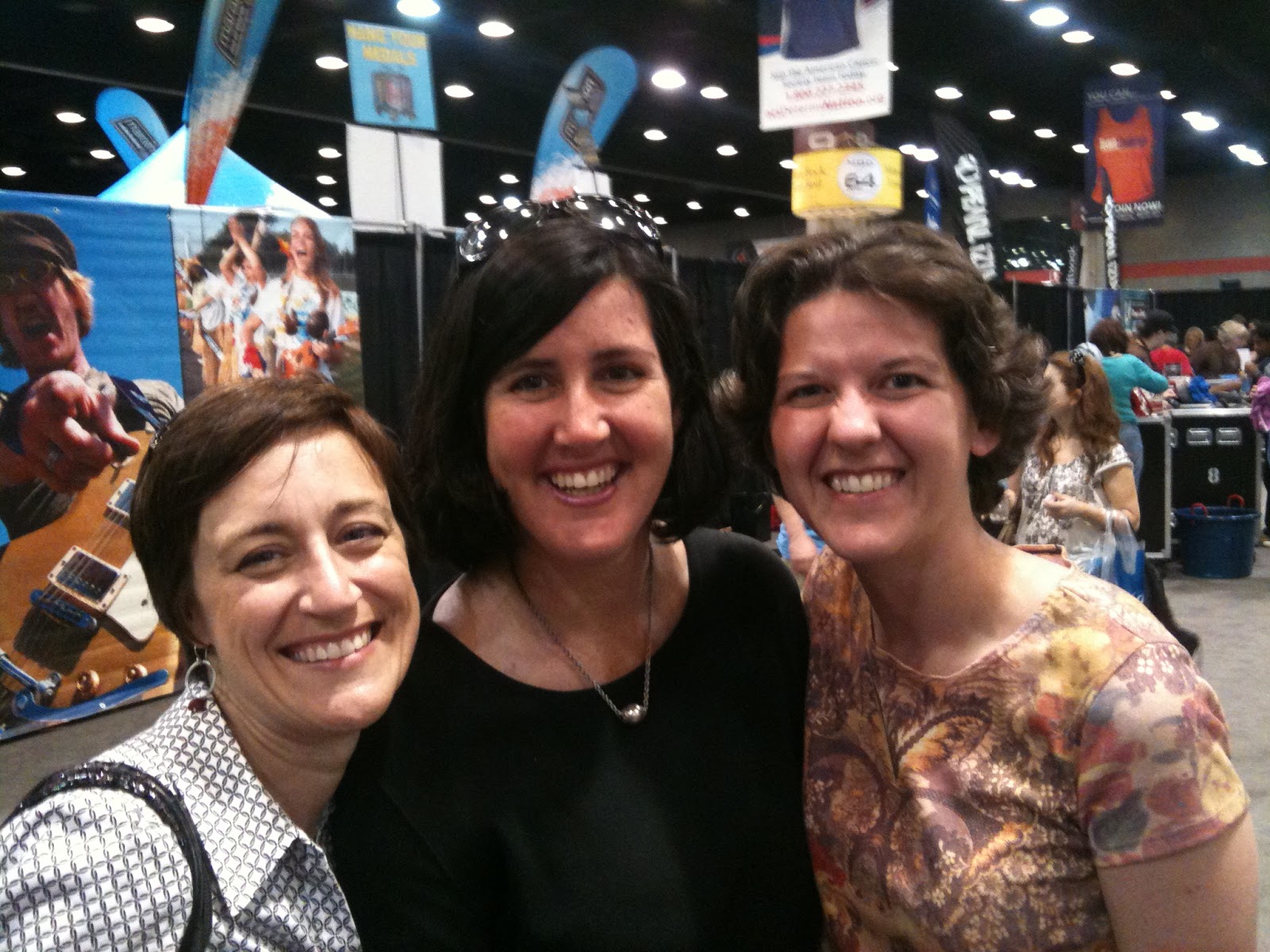
I then got my bib with my number on it, the tag I'd put on my shoe that would allow them to record my finish time, my race t-shirt, and a "goody bag" full of ads and sample products. I then negotiated the mass commercialism zoo that was the expo, with tons of running merchandise all for sale -- and I'm proud to say I resisted the urge to buy anything. While in the expo, I happened to run into two other girls from my seminary who were going to run the half-marathon as well; they're in the class behind me (they're first-year students this year) and have been training together since the fall. We'd been talking about the race on and off for most of the semester when ever we ran into each other. I got a picture with them (seen at right), "just in case I don't see you tomorrow," and it was a good thing I did, because I certainly did NOT see them at all the day of the race. It was very serendipitous we ran across each other at all in that great sea of people.

We stayed at the Nashville Music City Hostel, where we could park our pop-up van in the back lot and pay just $12.50 per person to use their common room and showers -- beats the hundreds of dollars we'd have had to shell out for a hotel room in downtown, and it was only a mile from Centennial Park, where the race began, so I was able to walk to the start line in the morning. And, there were a bunch of other people staying at the hostel who were running the half and the full marathon, so there was the added camaraderie of being up at 5 a.m. eating breakfast with other runners, and having people to walk over to the park with.

Pre-race in the park.
At the park, I waited in line for 35 minutes to use a porta-potty (apparently if you'd bought a certain amount of products at the expo the day before, you got to use the porta-potties in the "Brooks Premium Tent," where there were no lines and security guards to make sure no non-extravagant spenders got to pee without waiting -- guess money CAN buy you everything). While standing there, I struck up a conversation with a couple in line behind me who said they'd met someone at the expo yesterday who runs a full marathon every weekend. His goal was to run 52 marathons this year, they said. In fact, he was running the full marathon in Nashville and was then going to drive to Cincinnati to run a marathon there the VERY NEXT DAY -- on Sunday, May 1!! Just goes to show you that no matter what the subject, there's bound to be someone out there who will take it to an unhealthy extreme. I hope that man lives to be in his 50s -- at this rate of what he's doing to his body, it's doubtful!

I got out of the porta-potty a few minutes before the race was scheduled to start, at 7 a.m., but I wasn't worried about missing the start, since I was in one of the last "corrals," and I figured I'd have to wait quite a while before my group got to the start line. (They put the participants in different corrals based on their expected finish time and whether they're running the half or the full or if they're planning to walk it. The fastest people get to go first, so they get out of everyone's way and so they don't have to run around and over the slow people. I was in Corral 30, and I think there were only 32 or 35 total. So... pretty near the back.)

Waiting in line to start the race

I was right about not worrying about being there right at 7 a.m. -- it was 7:45 a.m. before my group actually got to cross the start line! This late start was what precipitated my bathroom stop just two or three miles into the race -- I've never had to stop on any of my long runs in training.

It was a beautiful day: not a cloud in the sky, and nice and cool at 7 a.m. The first half... or more than half... of the race was very pleasant, as we ran through parts of downtown Nashville and down "Music Row" (the street where all the music industry businesses are located). We looped around Belmont University and back up the other side of Music Row. The course actually went right in front of the house of one of my husband's friends who is a songwriter in Nashville. It was great fun to see people out in their front yards cheering us on, kids holding out their hands to get the runners to slap them as they went by, cheerleaders (literally) with pom poms and signs, and all sorts of creative messages from interesting spectators. My favorite: a guy sitting in a lawn chair at the edge of the road holding up a sign that said, "Worst parade ever." For the first several miles of the race, I was right beside a guy running in a huge neon green costume who was the mascot for some wireless phone company. At the place where the marathoners split from the half-marathoners to go on a different course, an Elvis impersonater stood directing traffic and giving high-fives to all the runners who went by.

But by the time 10 a.m. started rolling around and I got into the last several miles of the race, the temperatures had risen to probably in the mid-70s, and the heat was getting to me. I don't do well with running in anything much hotter than mid-60s, since most of my training has taken place since January, and at 2,000 feet elevation -- in much cooler temperatures. That's probably part of why I had to stop and walk some in the last mile and why I felt slightly dizzy afterwards. Around mile 11, I started to think, "Why on earth am I DOING this?? This was STUPID! I'll never do THIS again!"

But I'd programed my music so that as I got closer to the finish line, music by several people I know personally, including my own sister, Ashley Wells, showed up in my play list -- and many of them (including my sister) have run half and full marathons before. Hearing them singing in my ears helped me to feel like they were with me, encouraging me to keep going, and I went back to running for the last several tenths of a mile and crossed the finish line running!! (Below is the wide-angle version of the finish line shot -- I'm over on the right with my arms up in a victory celebration.)


Overall, it was a really exciting experience to be part of such a huge event, and to know that I was doing it for a greater cause. It was inspiring to see all the people running for Team and Training (of the Leukemia and Lymphoma Society, where my sister used to work), and for the American Cancer Society, and all the support that these groups had in terms of "cheerleaders" on the sidelines all along the route. Unfortunately, since my charity wasn't an official "running" charity, I didn't get one of the cool "in honor of" or "in memory of" bibs to put on my back like those runners did (pictured at right)... but I wrote in my own thing on my bib, at the bottom, in pen... so small no one at the race even noticed it, I'm sure, but I knew in my heart, and all of you out there who donated knew -- that I was "running in honor of Elena Rankin and thousands of other NICU babies."


When I started training seriously for this event in January, it was a struggle to run even two miles. Now I just ran over thirteen and have a half-marathon finisher's medal. It's been a wonderful journey and an inspiring process to push myself and to have a goal to work towards to get myself in shape and to raise money for a good cause.

I'd especially like to thank my personal trainers, Reid and A'ndrea Fisher, of St. Andrews-Sewanee School, who got me through that critical mid-training slump and helped me address the problems I was having with my IT band (muscle that runs from your hip to your knee on the outside of your thighs -- which I didn't even know EXISTED until I started running!) through core strengthening and hip strengthening exercises. And, of course, thank you to all of my donors who made this fundraising success possible. I couldn't have done it without you!

And last but certainly not least, thank you to my dear husband Thomasjohn for encouraging me to run on those days when I really wanted to blow it off, for putting up with my screams of pain while using the foam roller to loosen up my IT band after a long run, for encouraging me to hydrate well, and for being there at the finish line to cheer me on -- and then driving all over Nashville for hours trying to figure out how to find me and meet up with me in the midst of all the street closures!

And yes, I probably will do another one at some point in the future. What can I say? It felt great to finish.